DSR may be one factor in a lending decision. A lender may also consider verified income, existing obligations, repayment conduct, credit history, documents, eligibility and product policy. Only the lender can confirm the reason for an individual decision.
What is DSR (in plain English)
Debt Service Ratio is a comparison of how much you owe every month versus how much you earn every month. In PIDM's words, it's "how much of your income will be used to repay your loans."1
PIDM describes DSR as total monthly debt commitments divided by monthly income and states that its planning calculation uses net income after statutory deductions.1
DSR = (Total monthly debt commitments ÷ Net monthly income) × 100
Kira Dulu's DSR calculator defaults to gross income and also offers an estimated net-income view. Both are planning views, not a lender's underwriting formula.
A lender's affordability assessment may also consider necessary expenditure, financial buffers, recognised income, existing obligations and product-specific rules.11
Worked example — illustrative planning assumptions
Meet Aisyah. Gross salary: RM6,000/month. She wants a home loan.
The deduction and credit-card amounts below are simplified assumptions for this example. Actual payslip deductions and lender treatment may differ.
Step 1 — Find her net income. Statutory deductions come off first:
| Deduction | Rate | Amount |
|---|---|---|
| EPF (employee) | 11% | RM660 |
| SOCSO + EIS | ~0.75% | RM45 |
| PCB (income tax) | approx. | RM95 |
| Total deductions | RM800 |
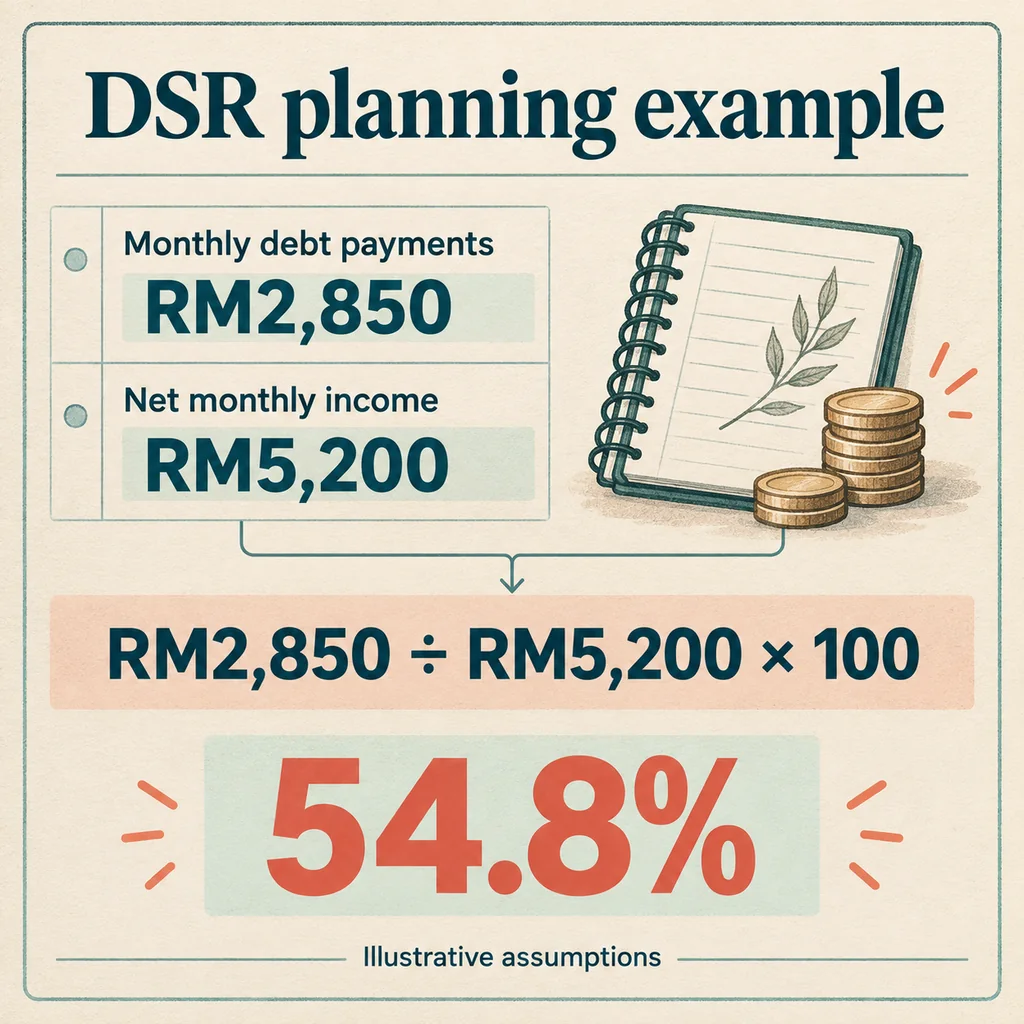
Net income = RM6,000 − RM800 = RM5,200/month.
Step 2 — Add up her existing monthly commitments:
| Commitment | Monthly |
|---|---|
| Car loan | RM750 |
| PTPTN repayment | RM200 |
| Credit card (5% of RM8,000 balance) | RM400 |
| New home loan instalment | RM1,500 |
| Total commitments | RM2,850 |
Step 3 — Calculate DSR:
RM2,850 ÷ RM5,200 = 0.548 → 54.8%
In this illustrative net-income example, a DSR of 54.8% means RM2,850 of RM5,200 is allocated to the listed monthly commitments. It does not predict approval.
What counts toward your DSR
Start with your actual monthly debt payments, including bank and non-bank commitments. For personal planning, record amounts from current statements rather than a remembered estimate.1
- Home, car and personal financing — record each monthly instalment.
- PTPTN and other contractual repayments — include the current monthly amount.
- Credit cards — record the balance and required payment separately. Ask the lender how it translates these into an assessed commitment; a percentage in our worked example is not a rule for every bank.
- Non-bank financing and BNPL — include recurring payments in your own budget. Do not assume that appearing or not appearing in a particular credit report removes an obligation from an affordability assessment.11
DSR vs CCRIS vs CTOS — three different things
DSR, CCRIS and CTOS describe different parts of an assessment.
DSR is a ratio calculated from income and monthly commitments. It is not the same thing as a credit report or credit score.
CCRIS is BNM's credit-reporting system. Its report shows financing and repayment history over the past 12 months as reported by participating financial institutions. It does not cover every lender or every debt. Borrowers can access their own report through eCCRIS.9
CTOS is a credit reporting agency registered and regulated under the Credit Reporting Agencies Act 2010. Its products may contain different information, so check the report type rather than assuming every report includes the same score or CCRIS data.149
A lender can consider credit information alongside affordability and its product rules. Read the existing CCRIS vs CTOS guide for more background; only the relevant provider can explain an individual report or decision.
What income documents help with a personal loan application?
A salary figure and evidence of that salary are different inputs. Gather current income records before comparing a proposed instalment with your budget.
If you are employed: a lender may ask for salary slips, an EPF statement, tax records or bank statements showing salary credits. If you are self-employed: business-registration documents, tax records and bank statements can help show the source and consistency of income. Maybank's current personal-loan page lists different evidence options for these two groups; check the selected product's own checklist because requirements can change.13
Keep a note of which income is regular, variable or one-off. Do not assume every allowance, business receipt or co-applicant's income will be counted in full. The lender must assess income and existing obligations alongside necessary expenditure and a financial buffer.11
Use your records in the DSR calculator, then compare the result with your own remaining monthly budget.
Before applying: five checks beyond the DSR percentage
- Check the inputs first. Use the same income basis throughout, include the proposed new instalment and remove duplicate entries. A corrected estimate is more useful than a lower but incomplete number.
- Review existing repayments and balances. PIDM suggests paying down debt and avoiding unnecessary credit-card spending. Before using savings for an early settlement, check the actual settlement figure and your remaining emergency funds.1
- Test a smaller proposed instalment. Hold income and existing commitments constant in the calculator, then compare alternatives. A longer tenure can reduce a monthly payment while increasing total borrowing cost, so compare both figures.11
- Prepare evidence of consistent income. Use records the selected lender accepts; do not add unverified income simply to improve the ratio.13
- Check the budget after debt payments. Rent, food, dependants and other living costs still need funding. A planning DSR alone does not establish affordability or approval.11
A joint application is not a universal shortcut: both applicants' income, obligations and product eligibility must be assessed. A credit-limit change also has no universal DSR effect; ask the lender which treatment applies.
Car loan, home loan, personal loan — same DSR?
The planning arithmetic is the same: monthly commitments divided by the chosen monthly income. The new instalment and a lender's recognised inputs can differ by product and applicant. Do not carry a percentage from one bank or product into another as an approval threshold.12
For a personal loan, use the eligibility calculator to explore an illustrative repayment budget. For a home or car loan, the relevant free calculator can help compare instalments; using a calculator does not require an enquiry or application.
Before comparing advertised rates: flat-rate and reducing-balance percentages describe different calculations. Use the existing flat-rate versus reducing-balance guide to understand the difference, then check the product disclosure sheet and total repayment for the actual offer.