Compare the years of debt as well as the monthly payment.
For an illustrative RM81,000 car loan on a 2.9% flat annual rate, the scheduled monthly payment works out to about RM1,546 over five years, RM1,160 over seven years and RM946 over nine years. Total interest rises from RM11,745 to RM16,443 and then RM21,141, so the lowest monthly payment also carries the highest full-term interest in this example.
The vehicle price behind the comparison is RM90,000 with a 10% deposit of RM9,000. Keeping the price, deposit and rate unchanged isolates the effect of the repayment period. It does not confirm that every term is available for the vehicle you choose, and the 2.9% flat rate is a hypothetical input for illustration, not a current bank offer.
Worked example: one principal, three commitments
With flat interest, total interest equals the principal multiplied by the flat rate and the number of years. The table uses the unrounded monthly figure for arithmetic; the "shown" values are rounded for reading.
| Term | Monthly payment (unrounded) | Monthly payment (shown) | Total interest | Total scheduled repayment |
|---|---|---|---|---|
| 5 years (60 months) | RM1,545.75 | RM1,546 | RM11,745 | RM92,745 |
| 7 years (84 months) | RM1,160.035714… | RM1,160 | RM16,443 | RM97,443 |
| 9 years (108 months) | RM945.75 | RM946 | RM21,141 | RM102,141 |
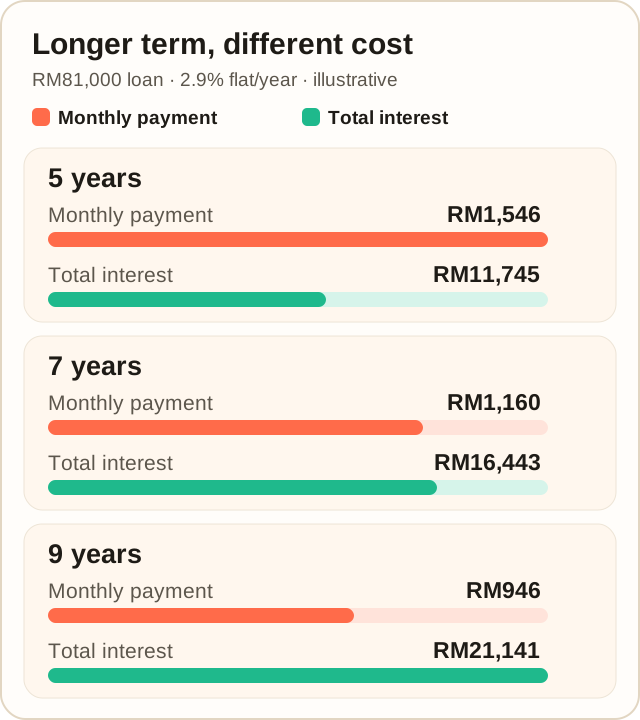
How the numbers are reached: RM81,000 × 2.9% × 5 = RM11,745 interest; RM81,000 + RM11,745 = RM92,745; RM92,745 ÷ 60 = RM1,545.75. The same steps for seven and nine years give RM97,443 ÷ 84 = RM1,160.035714… and RM102,141 ÷ 108 = RM945.75. (The seven-year figure rounds to RM1,160.04 to the sen, or RM1,160 to the nearest ringgit.)
These repayment totals exclude the RM9,000 deposit and ongoing running costs. They are financing comparisons, not complete ownership-cost totals.
Flat rate vs. effective rate
The 2.9% figure is a flat rate applied to the original principal for the full term. Because you repay part of the debt every month, the effective cost of the money is higher than 2.9%. The table below converts each flat-rate cash flow to a monthly internal rate of return (IRR), then annualises it in two ways.
| Term | Monthly IRR | Annualised (monthly × 12) | Compounded annual equivalent |
|---|---|---|---|
| 5 years | ≈ 0.455% per month | ≈ 5.46% | ≈ 5.60% |
| 7 years | ≈ 0.450% per month | ≈ 5.40% | ≈ 5.53% |
| 9 years | ≈ 0.444% per month | ≈ 5.33% | ≈ 5.46% |
The "annualised (monthly × 12)" column simply multiplies the monthly rate by twelve; it is not a compounded annual yield and not a lender's fee-inclusive quotation. The "compounded annual equivalent" column compounds the monthly rate over a full year. Neither column is a rate your bank is quoting today; they are arithmetic equivalences of this hypothetical flat-rate example only.
The linked car-loan calculator shows a quick educational estimate using flat rate × 1.8 (5.22% if you enter 2.9%). That shortcut is not this table's term-specific cash-flow IRR, so the displayed rate figures will differ even when the monthly payment and total-interest maths match. Neither is a substitute for the lender's disclosed effective rate and full quotation.
The equivalent percentage drifts slightly lower as the term lengthens here, while the ringgit interest bill rises. A percentage alone therefore cannot tell you which option costs less overall; compare the amount borrowed, the total paid, the term and any fees together.
Do not apply the 2.9% flat formula to a reducing-balance offer. A contract on a different repayment basis needs its own schedule. The examples describe an older or transitional flat contract and do not describe all current new financing.
Think about how long you will keep the vehicle
Write down the likely replacement date before choosing a term. If you plan to change cars earlier, ask the lender how settlement is calculated rather than assuming the full-term interest totals describe the cost of your plan. This guide does not calculate any guaranteed early-settlement discount.
Also budget for using the car for the whole loan. Insurance, fuel, maintenance, road tax, parking and repairs sit outside the instalment comparison. A payment that feels easy in year one can still compete with those bills later. Consider whether the vehicle will still meet your needs for the years you remain committed.
If the five-year payment is too high, compare a lower vehicle price as well as a longer term. That gives you two ways to reduce the payment and makes the trade clearer. Keep the deposit realistic in both scenarios; borrowing it elsewhere changes the overall debt picture.
Check the quotation method
Malaysia's hire-purchase transition runs from 1 June 2026 to 31 March 2027. During this window some banks may still originate flat-rate or Rule-of-78 contracts, while others may quote on a reducing-balance basis, so the quotation method must be confirmed with the lender. There is no single universal formula for every new contract. ABM says eligible customers who settle fixed-rate Rule-of-78 agreements early will receive goodwill discounts. Eligibility conditions apply; the bank calculates the exact amount for the agreement and settlement timing and provides it when a settlement quotation is requested. ABM/AIBIM/ADFIM transition statement.
The 2.9% flat-rate calculation here describes an illustrative older or transitional flat contract; it is a hypothetical assumption and not a current bank rate or the standard for every new agreement. A flat rate applies to the original amount throughout the stated term. A reducing-balance quotation needs a different calculation. Ask for the effective rate and the total scheduled repayment, then compare equivalent amounts and periods.
What the lender actually looks at
This budget exercise does not assess your credit record, confirm your income or approve a particular vehicle. Ask the lender about vehicle eligibility, deposit, available term and the income evidence it requires. A car within your spending limit may still fail the lender's assessment. Conversely, an available loan does not prove that its running costs fit your household.
Before accepting a quotation, separate the vehicle price from accessories, insurance and optional packages. Check which items are financed and which must be paid in cash. Keep the deposit fund separate from money for servicing or an unexpected repair. If you expect to sell early, request a settlement illustration for that timing; the remaining debt is not simply the number of instalments left multiplied by the instalment amount.
Is a nine-year car loan always the wrong choice?
This example only shows the financial trade. Your budget, the available contract and your expected ownership period still matter.
Why is the effective equivalent above 2.9%?
The flat quotation applies to the original principal, while the equivalent calculation reflects the repayment cash flows as the debt is paid down.
Are these totals what I would pay to settle early?
No. They are scheduled full-term repayments. Obtain the lender's settlement quotation for the actual date and agreement.
Calculate with your own numbers
Indicative planning only; not a guarantee of approval or of any particular rate.
Sources
- ABM/AIBIM/ADFIM hire-purchase transition statement — statement published 16 March 2026; reviewed 16 September 2026.